
For distributors and finance teams
AI data reconciliation for partner and vendor data
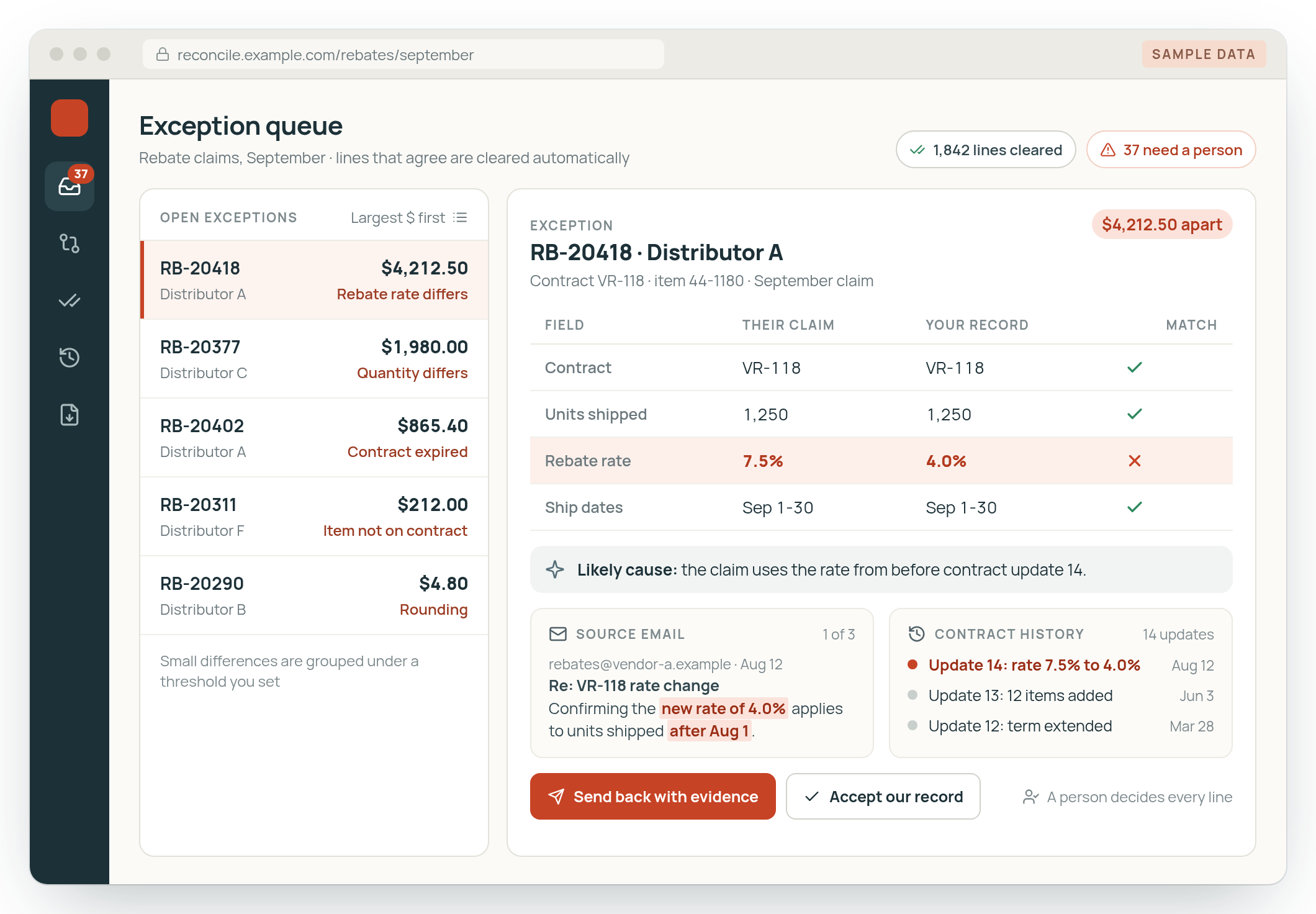
Every line of a partner's or vendor's data is matched against your records, and the lines that agree clear on their own. Each mismatch goes to a person with the source emails and contract history attached, largest dollar amount first.
- Rebate claims against contracts
- Invoices against contract prices
- Daily inventory variances
- Itemized bills against expected charges
Before and after
One data mismatch, two ways
The left side is how a master distributor described the work on a call. The right side is what we proposed.
By hand, as described on a call
Any order- Cross-reference their data to yoursline by line
- Dig up the original emailsbecause a lot of it comes in by email
- Check the contract historyand whether it reached the system
- Repeat for every mismatch20 minutes to half a day, dozens of times a week
Proposed review queue
Proposed- Every line matchedon fields your team trusts
- Lines that agree clearwith a record of what they matched on
- Mismatches queue uplargest dollar first, evidence attached
- A person decides each oneaccept it or send it back in one click
Proposed, not measured. Tenfold has not built this for that company, so nothing on the right is a result.
From our calls
A lot of our work is actually manual cross-referencing their data to our data.
I get a report every day and it's got all these variances and... it doesn't tell me anything.


Photo: Viktor Talashuk on Unsplash. Photo: Ruchindra Gunasekara on Unsplash.
Who this is for
Teams that check one dataset against another for a living.
Most of the hours go into the lines that don't agree. Someone finds the emails, confirms the data and checks it reached the system.
Where the data lives
- Distributor sales claims
- Rebate contracts
- Invoices
- Inventory variance reports
- Itemized bills
How AI data reconciliation works
Three steps, your systems
Your systems change the details. The order stays the same.
- 01
Match every line
Both sides load from the files, databases or emails they arrive in. Lines match on contract, item, customer and amount.
- 02
Clear what agrees
Matching lines clear with a note of what they matched on, so anyone can check later.
- 03
Queue the rest with evidence
Mismatches arrive with the related emails and contract history, sorted by dollar amount. A person decides every one.
Proposed, not built yet
We haven't built this one for a client yet
- We proposed this review queue to a master distributor that handles vendor rebates.
- A billing team at a services company asked for exceptions sorted by dollar value, with a one-click send-back.
- Until a version is built and measured, this page publishes no time saved and no result.
How often data reconciliation comes up
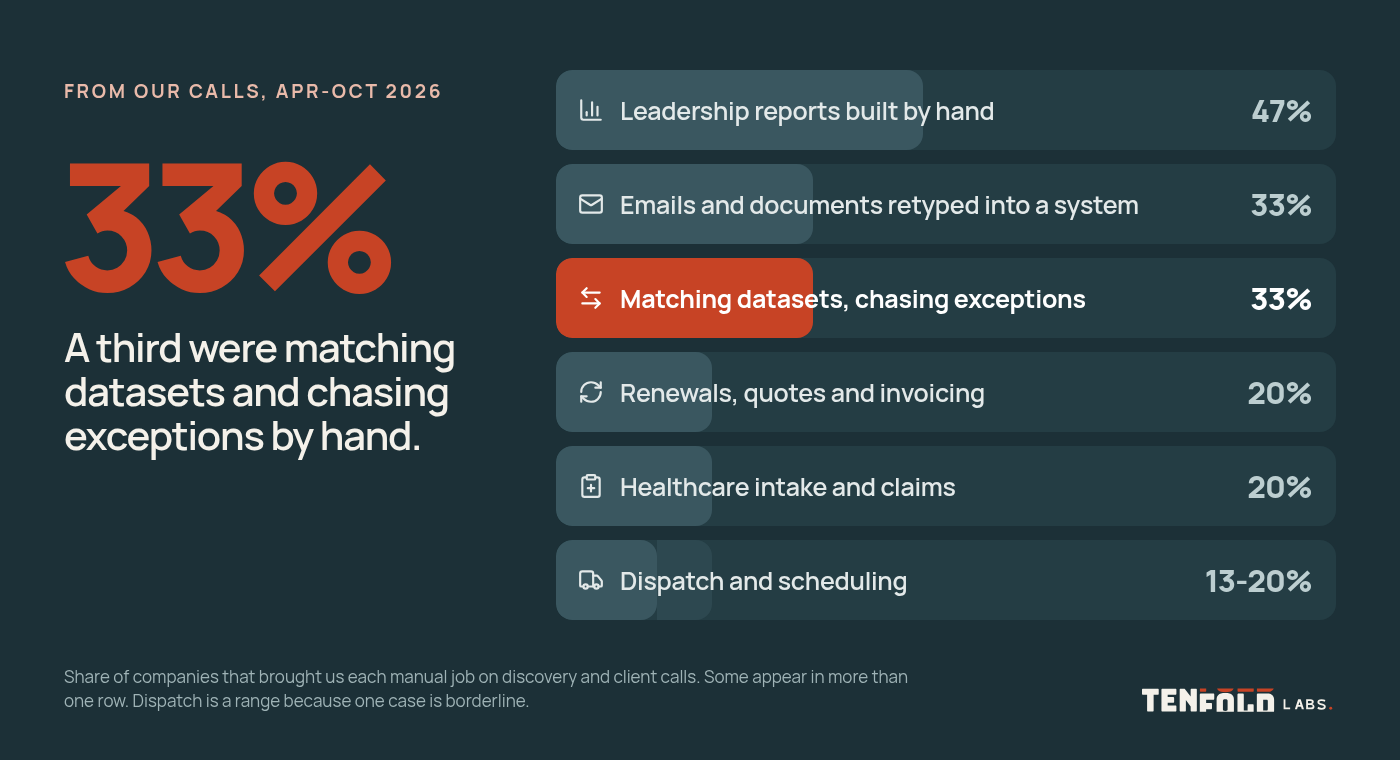
33% of companies on our calls
About a third of the companies on our calls described matching datasets and chasing the exceptions.
Getting started
What a first version takes
What to bring
- A recent export from each side
- A few mismatches with the answer your team found
- The person who knows where the emails and contract history live
What you see first
We match the sample and show you which lines would clear and which would go to a person, before a full build. Your team decides what counts as a match.
Questions
Common questions
Watch the 36-second version
36 seconds. Narration is a synthetic voice. Screens are samples, not client data.
Is this AI or a set of rules?
Both. Exact matches are checked by rules you can read. AI helps read emails and documents and suggests a likely cause, and a person decides every mismatch.
Can it suggest why a line doesn't match?
That is what one distributor asked for. He wanted a system that would say to go check another item "because the past 32 times that this thing was pulled, it was that thing." The review queue can show past outcomes for similar lines once your history is loaded.
What if every line has to be right?
Then nothing clears unless it passes the checks you set, and everything else waits for a person. A medical bill review team we spoke with got 90 to 95 percent accuracy reading 300-page bills with its own scripts and needed 100 percent.
Do we have to change our systems?
No. The matching reads the exports and records you already have, and the results go back as files or into the system your team uses.
What about mismatches worth very little?
You can set a threshold so small differences are listed together instead of each being investigated, and the queue puts the largest amounts first.
How do we start?
Use the contact page or email scott@tenfoldlabs.io. Tell us which two datasets you compare and how often.
Send us a sample of both files
Send a recent export from each side and a few mismatches your team already solved. We'll show you which lines need a person and whether a first version makes sense.
You work directly with Scott Hanson, who scopes the first version with your team and builds it. Based in Austin.
Or email scott@tenfoldlabs.io